Listen to this essay · 6 min
Words move algorithms. They change our perspective. They deliver us joy, and they deliver us pain. I have been thinking about that a lot, because AI lives on words. It is through combinations of words that machine learning gives us the results we are looking for, and those combinations can mean very different things.
In the world of AI, as in the world of life, we are always searching for the right words: the words that will give us the answers we need. Sometimes we find them. Sometimes they just are not there.
The Bible puts it more sharply than I can. The verse I had in mind is Proverbs 18:21. In the New International Version it reads: "The tongue has the power of life and death, and those who love it will eat its fruit." Your words have weight. You live with what they grow.
Here is the puzzle I want to sit with. As you explore your life with artificial intelligence, it is a great allegory for how life itself works, because in both places we are looking for the right words.
01The right words get the deal
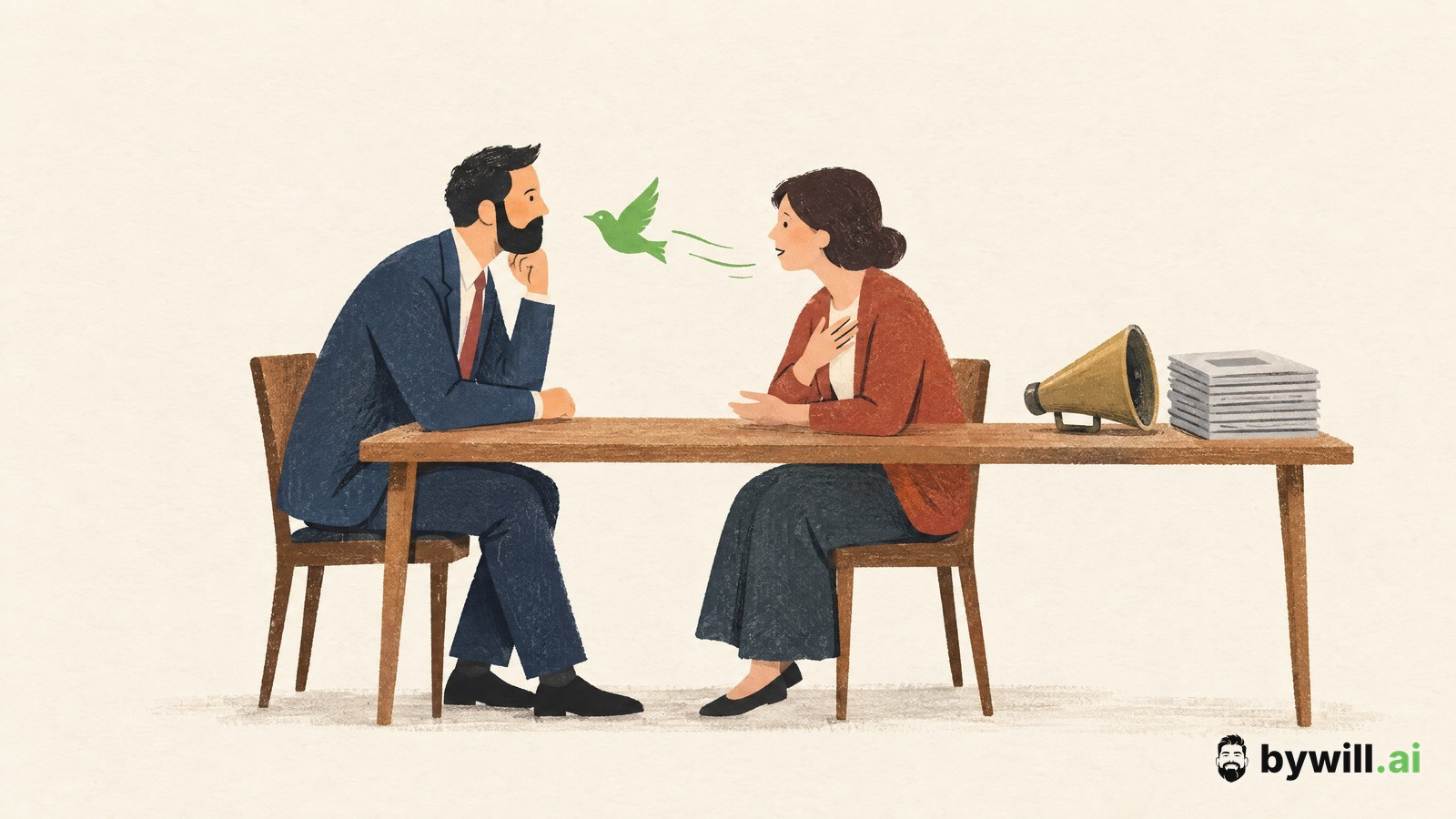
The right words will get us the deal. The right words will get us that relationship. The right words will get us the solution, or find something for our problem. That is true in a prompt, and it is true across a table from another human being.
Sometimes words come out as regular and normal. Sometimes they come out of us with real strength and power. Sometimes they are just the expression of our soul. We know the difference when we hear it, in a conversation and on a screen.
Insight: prompting is not a hunt for magic phrases. It is the same old work of saying clearly what matters.
02Songs you sing, and songs you shout
There are songs you sing introspectively, quietly, almost to yourself. And there are songs you shout, because those words have meaning and they have to be heard. Both kinds are real. Both have their place.
A prompt can be like that too. Some requests should be gentle and exploratory: a brain dump, a half-formed thought, a "I'm not sure yet, help me find it." Others need to be spoken with force and precision, because the job is serious and the detail matters. The skill is knowing which song you are in.
Insight: volume is not the same as power. The quiet word and the shouted word can both be the right one, if they are true.
At the end of the day, it's the client that has the words.
03Three vocabularies, and the client has the words
So how do you find the right words for the solutions you are looking for? You have to look at the words your industry uses, the words your client speaks, and the words you speak yourself. Your job is to find the puzzle of those three vocabularies, and fit them together.
Sometimes the industry will have broad words that stand in for what the client actually means. You may have words of your own that showcase what the client has to say. But at the end of the day, it is the client that has the words. From a business perspective, you need to think about what they are thinking, not only about the language that feels natural in your trade.
Insight: if your prompt is full of your jargon and empty of their life, you should not be surprised when the answer misses them.
04The word to focus on is empathy
Maybe the word we need to focus on is empathy. Empathy for their pain. That is not a technical trick to paste into a prompt. It is a mindset.
What is empathy, in this sense? It is the context. It is understanding the problem you are trying to solve, with as much detail as possible. Sometimes the problem is not "write a process document" or "automate this workflow." Sometimes the problem is: I am spending too much time on this task, and I cannot get home to my kid in time. That is a real problem. For the person living it, that is worth a lot of money they are willing to pay.
If you can name that, in life and in a prompt, the work changes. You stop asking for a slightly faster task, and you start asking for a way home.
Insight: empathy is context, and context is the problem in detail, not the problem in slogan.
In short
AI lives on words, and so do we. The combinations we choose can open a door or close one. The tongue, as Proverbs says, has the power of life and death, and we eat the fruit of what we love to say. So look at the three vocabularies, put the client's words first, and let empathy be the mindset, not a gimmick. Then ask yourself the question I have been asking:
What are the words that, if you started using them in your life and in your prompts, would give you a better solution?
Words can move a market,
or a model, or a friend;
they carry joy and they carry pain,
and they shape the way things end.
So listen for the client's words,
and name the problem true:
empathy is the context,
and the right words see you through.
"The tongue has the power of life and death, and those who love it will eat its fruit." — Proverbs 18:21, New International Version
It was not written about machines. It was written about us. The fact that our machines now live on words only makes the old warning more practical.
If you want this practised with your team, have a look at AI training for teams.
So, what are the words? What are your insights?
— Will
Written by Will, with Bloggy, his AI editor