
Listen to this essay · 15 min
"Luddite" is one of the few insults we hand out to whole generations. Your uncle who will not use online banking is a Luddite. So is the colleague who prints her emails. The word now means someone who is afraid of machines.
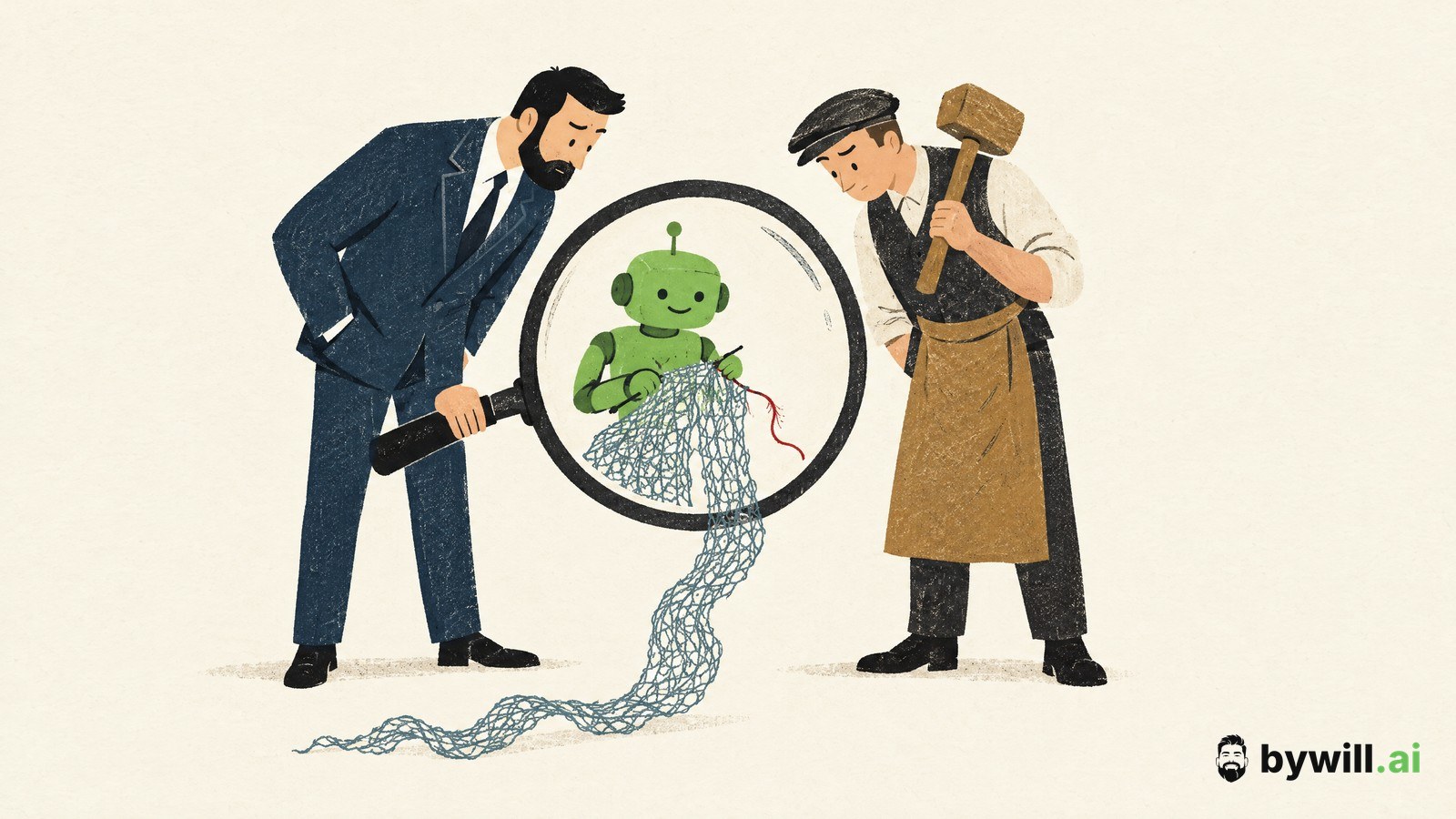
The people who first carried the name would not recognise that description. In 1811 they were skilled textile workers in the English Midlands, and they knew their machines better than almost anyone alive. What they feared was not the frame, the shears or the loom. It was what the people who owned those machines had decided to do with them.
I have been reading two books that look at the same question from opposite ends. The Sovereign Individual, by James Dale Davidson and William Rees-Mogg, which I am still working through, expects a new wave of "Luddites" to rise against the information age. AI Superpowers, by Kai-Fu Lee, expects artificial intelligence to hit factory floors and office towers alike. Before choosing a lens, it is worth getting the original story right.
01The real story
The National Archives puts it plainly. The disturbances "started in Nottinghamshire in 1811 and spread primarily to the West Riding of Yorkshire and Lancashire in 1812, then later on to Leicestershire and Derbyshire." These were textile workers, "many of whom had spent years learning their craft."
They had a general, and he did not exist. Ned Ludd, sometimes "King Ludd" or "General Ludd", was in the Archives' words "a legendary and mythical leader", an imaginary figurehead said to live in Sherwood Forest. Letters went out in his name. One surviving note, "Ned Lud's Proclamation" of 23 December 1811, threatens death to anyone who gives information about frame breaking, and is signed "by order of King Lud". A myth turned out to be very practical: nobody can arrest a man who isn't there.
The movement started gently. In early 1811, Nottinghamshire knitters slipped into workshops and removed the jack wires from certain frames. That stopped the frames working without wrecking them. Only after talks with the hosiers failed did the breaking begin in earnest. The Luddites also petitioned, protested and wrote to officials and employers. The hammer is just the part history remembers.
Insight: the Luddites were not people who had never seen a machine. They were people who knew exactly what this one would do to their trade.
02What they actually broke, and why
There were three trades in three regions, and each had its own grievance.
In the Midlands, the framework knitters made stockings on knitting frames, usually rented, and paid the rent whether there was work or not. Their quarrel was with the wide frame. It made a broad flat sheet that was cut to shape and sewn up into a "cut-up": quicker, cheaper and inferior to a properly fashioned stocking. Wide frames were often worked by "colts", people who had not served the traditional seven-year apprenticeship. The Nottinghamshire Heritage Gateway draws the line carefully: the knitters "were not fundamentally opposed to the wide frames or the colts", but they were opposed to employers relying on them during a slump. A magistrate writing in February 1812 said the breakers went after frames belonging to hosiers who paid "reduced prices". One reward poster from January 1812 even carries a statement from the knitters at George Ball's Lenton workshop, saying their frames had been working "at the FULL PRICE" when the mob broke them anyway.
In Yorkshire, the croppers finished woollen cloth by hand with heavy shears, and they were well paid for it. Shearing frames and gig mills threatened that work. In April 1812 more than a hundred men attacked William Cartwright's Rawfolds Mill. He was waiting for them with soldiers, and the attack failed. Later that month a mill owner, William Horsfall, was shot dead on the road home.
In Lancashire, the handloom weavers faced the power loom. On 24 April 1812 a crowd burned the Westhoughton mill and its 180 power looms. Four men were hanged for it at Lancaster Castle. One of them, Abraham Charleson, was officially listed as sixteen and may have been as young as thirteen.
Look at the targets: wage cutting, unapprenticed labour, cheap substandard goods during a depression. The historian Eric Hobsbawm called this "collective bargaining by riot". Even The Sovereign Individual, which has no soft spot for them, concedes that the workers "were quite discriminating in their opposition to new technology". When a new carpet mill came to the same district, making a product nobody locally had specialised in, there was no violence at all.
Insight: the Luddites drew a line between a new machine and a machine used to undercut the people already doing the work. We tend to forget that line.
They did not hate the frame. They hated what the frame was being used to do.
03The gallows and the poet
The government did not draw that line. Thousands of troops were sent into the disturbed counties. (You may have read that more soldiers fought the Luddites than fought Napoleon in Spain. They didn't, and historians have taken that claim apart.) In March 1812 Parliament passed the Frame Breaking Act, which made destroying stocking or lace frames a felony punishable by death. Lord Liverpool's case in the Lords was frank: "the terror of the law" would work where lesser punishments had failed.
One peer stood up against it. On 27 February 1812, in his first speech to the House of Lords, the young Lord Byron described what the wide frames had done. "One man performed the work of many, and the superfluous labourers were thrown out of employment." The work itself "was inferior in quality; not marketable at home, and merely hurried over with a view to exportation. It was called in the cant of the trade, by the name of 'Spider work.'" Then he asked a question that still stings: "Will you erect a gibbet in every field and hang up men like scarecrows?"
They passed the Bill anyway. At a Special Commission in York in January 1813, seventeen men were hanged. Three of them, for Horsfall's murder, were cloth workers in their early twenties. Some of the others went to the scaffold singing a Wesleyan hymn.
Fair-minded historians do not turn this into a fairy tale. Some argue the Luddites were defending a relatively privileged trade, that only a small share of textile workers ever joined, and that the machines in the end made cloth cheaper for ordinary families. All of that can be true. E. P. Thompson's famous aim, in The Making of the English Working Class, was still to rescue "the Luddite cropper" from "the enormous condescension of posterity". In their lost causes, he wrote, "we may discover insights into social evils which we have yet to cure."
Insight: "spider work" is the oldest description I know of what we now call AI slop. It is quick, plausible and flimsy, and someone else ends up paying for it.
04Lens one: the sovereign individual
The Sovereign Individual came out in 1997. Its argument, put simply, is that information technology lowers the cost of leaving: leaving a job, a jurisdiction, even a tax system. The rewards will flow to highly skilled, mobile people who no longer need a nation-state to hold them in place. In that story, Luddites past and future are people resisting a change in the economic order itself.
The authors expected a backlash and named it. "The good news about individual liberation and autonomy will seem to be bad news to many who are not among the cognitive elite." The reaction, they wrote, would be strongest "not among the very poor but among persons of middling skills, underachievers with credentials, who came of age during the industrial era and face downward mobility." They call the moral fuel of that anger "moral anachronism": applying the rules of one economic age to the circumstances of another.
The lens is sharp, and it cuts both ways. The book's own retelling of 1812 runs hotter than the record. It has Luddites "murdering factory owners", when one mill owner was killed and another survived an attempt on his life. It also describes the reaction more than it listens to it. Still, one line from the book has stayed with me: "Reality is nonlinear. But most people's expectations are not." The croppers expected their trade to change slowly, at the pace of custom. It didn't.
Read through this lens, AI is the ultimate amplifier for the individual. A solo consultant, a ten-person firm or a teacher with a laptop can now do what once needed a department. Those who learn to use it gain, and those who refuse lose ground.
Insight: the sovereign lens says AI rewards the person who can stand on their own. The open question is what happens to everyone standing next to them.
05Lens two: the superpowers and the stipend
Kai-Fu Lee looks from the other end, from the scale of nations and platforms rather than the individual. In his 2018 book he describes a race with two runners. In his TED talk that year he put it this way: "the US leading the era of discovery and China leading the era of implementation", the "dual engine of the two superpowers".
His warning about work is blunt. In an essay adapted from the book, he writes that the disruption "will hit many white-collar professionals just as hard as it hits blue-collar factory workers." The steam engine, he notes, "only took over physical labor"; AI "can perform both intellectual and physical labor". Jobs that are "asocial and repetitive" are likely to go entirely. Jobs that are repetitive but social keep a human part. The safest are those that need "creativity, strategy and sociability". And because "AI is inherently monopolistic", the gains flow to those with the most data and capital.
Here he sounds most like Byron. Silicon Valley's favourite remedy, a universal basic income, strikes Lee as "an elegant technical solution to tangled social problems". He grants that "some form of guaranteed income may indeed be necessary", but calls it "an economic painkiller". He would rather pay people properly for care work, community service and education, and use the bounty "to double down on what separates us from machines: human empathy and love." After a cancer diagnosis that reordered his own priorities, he told the TED audience: "I can responsibly tell you that AI has no love."
Insight: the superpower lens says the real question is not whether the machines arrive, but who owns them, who is displaced, and what we choose to pay for once they do.
06What a small firm can do about it
You do not need to pick a side in a geopolitical argument to act on the lesson of 1812. The Luddites' complaint was rarely "a machine exists". It was "this machine is being used to cut our pay, skip our training and ship worse work." Those are management choices, and small firms make them every week.
- Use AI to lift the craft, not to cheapen it. If a tool lets a junior skip the work that made your seniors good, give them another path to that skill.
- Refuse spider work. Set a quality bar for anything AI touches, and keep a named human accountable for meeting it.
- Share the gains on purpose. If AI saves your team ten hours, decide out loud where those hours go: better service, learning, or an earlier finish on Friday.
- Talk before you deploy. Most of the Luddites' trouble came after employers refused to negotiate. Tell people what is changing, and why, before the frame arrives.
- Keep the human part human. Both lenses agree on this. Sales, care, teaching and judgement are where people are still worth most.
There is an old saying that fits. We usually say "the devil is in the details", but the older form puts God there. The earliest record is the art historian Aby Warburg's motto for a 1925 Hamburg seminar, "Der liebe Gott steckt im Detail": the good Lord is in the detail. It is often credited to Flaubert, and later to the architect Mies van der Rohe, but neither has been shown to be the source. The devil only moved in later in the twentieth century. For a firm bringing in AI, I prefer the older version. The detail is where care lives: who is trained, who checks, who gets the time back. Care is the thing a machine cannot supply.
Insight: you are not choosing between the machine and the people. You are choosing how the machine treats the people, one detail at a time.
In short
The Luddites were skilled workers in Nottinghamshire, Yorkshire and Lancashire, between 1811 and 1816. They broke the machines that were being used to cut their wages, replace apprentices and flood the market with cheap work, and the state answered with the gallows. "Luddite" later came to mean someone who fears technology, which is not what they were. The Sovereign Individual sees AI freeing the skilled individual, with a backlash from the middle. AI Superpowers sees two nations and a few platforms capturing the gains while blue- and white-collar work is displaced, and asks us to pay for love and care. For a small firm, the practical answer is the same either way: the outcome depends on the details.
Before the frame, before the loom, a story worth the telling.
They knew the frame from wire to wheel,
they knew the shears and stocking;
they did not hate the clever steel,
but the wages it was docking.
The cut-up, cheap and hurried through,
the colt who learned no trade,
the pay that shrank while profit grew:
that's what the hammer weighed.
Now models write and models draw,
and two great powers race,
while sovereign solos make the law
of who keeps up the pace.
So mind the detail, not the dread:
the good Lord's in the small,
in who is trained and who is fed,
and who is kept at all.
"You may call the people a mob, but do not forget, that a mob too often speaks the sentiments of the people." — Lord Byron, House of Lords, 27 February 1812
Byron did not stop the Bill. He did leave us a test, and it still works: when people push back against a new machine, listen to what they are actually saying before you call them names.
If you want to bring AI into your team in a way that raises the craft rather than cheapening it, a Strategy Session is a good place to start.
So, which of the two lenses do you lean towards: the sovereign individual or the superpower race? What are your insights?
— Will
Written by Will, with Bloggy, his AI editor