Listen to this essay · 10 min
The question I keep getting is no longer "should we use AI?" It is "what should we automate first?" People have a licence, a sense of urgency, and a long list of chores. What they want is three jobs that will actually pay their way.
Yesterday, in Less chat, more cheque, I set Gartner's three doors — revenue, cost and risk — against the map of where the large numbers sit. This is the next step. How do you pick the first three workflows, and how do you run them so they earn their keep? The same advice holds for a ten-person firm, a teacher, a consultant, or a team inside a larger organisation. A small shop can hold a big brain, if it chooses the work with care.
With that in mind, here are five things worth knowing before you hand over the first jobs.
01One job through each door
Start by naming the door, then pick the job. One workflow aimed at cost and time. One aimed at revenue, at getting a better offer in front of someone sooner. One aimed at risk, at catching trouble before it walks out of the door. You do not need thirty experiments. You need three you can actually change.
In a July 2025 survey of 1,973 managers, Gartner found that business units that redesign how work gets done, rather than just deploy AI and encourage people to use it, are twice as likely to exceed revenue goals. The same research advises leaders to identify the top two or three redesigns in each function. That is a useful scale. Not a transformation programme. Three jobs.
Here is a simple starter set, drawn from the supporting work Gartner already flags and from the "quick wins" on its public guidance: generating documentation, automating repetitive tasks, and improving how you deal with customers. First, a drafting workflow — quotes, briefs, lesson plans, a weekly update — where the machine carries the blank page and you still send the thing. Second, a research-and-outreach workflow: a first pass on a proposal, a campaign or a customer brief, so a person spends their time on the judgement, not the gathering. Third, a review workflow. Before something goes out, the machine flags weak claims, missing sources or a clause that does not match the last version. It does not decide. It holds up a hand.
In this Journal those three already have names. Bloggy drafts and checks the sources. I still write the view, and nothing is published without my yes. Grok at work, part two was about that gate. This part is about choosing the jobs that walk up to it.
Insight: if you cannot name the door a workflow walks through — more revenue, lower cost, or less risk — you are collecting tools, not picking work.
02If the files are a mess, the brain is blind
A workflow is only as ready as the material it needs. IBM's public guidance on putting AI to work is blunt about this. Define a precise, measurable goal, then assess whether the data is accurate, complete, consistent, relevant and actually reachable — in a form the tool can use, and without pouring sensitive information into a public box. In the IBM materials I have been studying, the same idea comes down to three checks: have you defined the business goal, can you build the capability, and is the data ready?
That last check is the one most people skip. If last year's quotes live in six inboxes and nobody can find the approved boilerplate, a clever assistant will only help you produce a polished guess. Work backwards from the job to the files it needs. If you cannot point to them, pick a different job, or tidy the drawer first.
Insight: if you cannot put your hand on the files the job needs, you do not have a workflow. You have a demo.
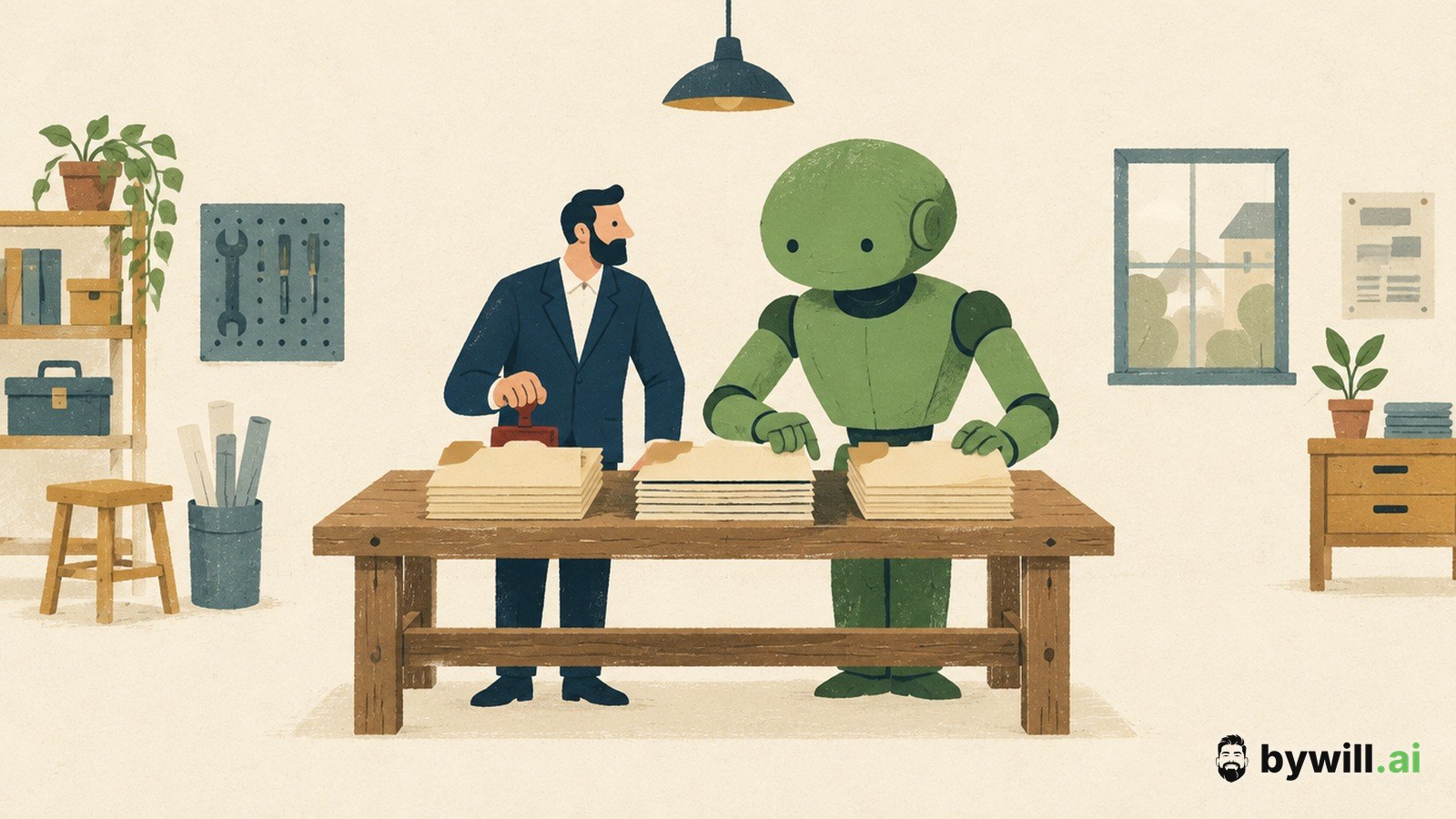
Automate the carrying. Keep the choosing, the relationships and the yes.
03Pilot it, then give it a number
IBM also advises starting with a pilot: a small, low-risk trial you can learn from and refine before anything is rolled out more widely. The goal should be precise enough to evaluate. Speed, accuracy, cost, a shorter cycle, a better first draft. "We used it a lot" is not a result.
Give the pilot a window and a measure: one workflow, a few weeks, a number you will look at honestly at the end. Gartner's Harsh Kundulli put the wider picture plainly in October 2025: only one in five AI initiatives achieves a measurable return, and just one in 50 delivers disruptive value. The way through that statistic is not a bigger licence. It is a smaller, clearer test.
Insight: a pilot without a number is a hobby. Decide in advance what "this paid its way" will look like.
04The hard week is the human one
The licence is the easy part. Gartner's public guidance has been saying for some time that organisations which invest in training and change management are more likely to see a positive return, and that the total cost often exceeds first estimates once you count the hidden work. In its 2025 IT Symposium keynote insights, Gartner's own position is sharper still: for every 100 days of implementation, expect about 25 more days training staff and a further 100 to 200 days of change management.
That is the unglamorous truth. Someone has to learn the new rhythm, and stop doing the old job in parallel "just in case." Gartner's July 2025 survey of 3,029 employees makes the same point from the other side. Only 3 per cent were consistently getting real value from AI. With guidance, that share rose to 15 per cent. The tool did not change. The help around it did.
When you pick the first three workflows, budget the teaching and the habit, not just the subscription. A small team and a large department both fail in the same way: they install the brain and forget the people.
Insight: buy the tool in a week if you like. Spend the next months teaching the new way of working, or the old way will quietly win.
05Keep a human at the gate
Some work should never go out unsupervised, not because the machine is useless, but because the consequence is yours. Gartner's own "when not to use" list is a good set of stop signs. Do not lean on this kind of model for serious numerical forecasts. Do not let it make critical decisions on its own, because a confident wrong answer can still look like a plan. And be very careful with proprietary or confidential information, especially in public tools.
The practical rule is the one I already use with Bloggy, and that I would use with any assistant, Grok included. Reversible, internal first drafts can run with a light touch. Anything that spends money, names a person, goes to a client, changes a record or is hard to undo waits for a human yes. The machine can carry the work to the edge of the desk. The stamp stays in your hand.
Insight: automate the carrying. Keep the choosing, the relationships and the yes.
In short
Pick three workflows, one through each door. Make sure the files are ready. Run a short pilot with a number attached. Spend at least as much care on the people as on the tool. And write down, before you start, what must still pass through your hands: the wisdom, the context and the yes.
Start with three jobs, not thirty.
A small shop can hold a big brain
if the work is chosen with care:
one door for the cost of the day,
one door for the custom you serve,
one door for the trouble you catch
before it walks out of the door.
But the files must be ready,
the pilot must have a number,
the people must learn the new rhythm,
and the yes must stay in your hand:
let the machine do the carrying,
and the choosing stay where you stand.
"Business units that redesign how work gets done, rather than just deploy AI and encourage employees to use it, are twice as likely to exceed revenue goals." — Gartner, July 2025 survey of 1,973 managers
It is a long sentence. The useful part is short. Redesign the work. Do not just buy another seat.
If you want a hand choosing those first three workflows, a Strategy Session is a good place to start.
So, which three jobs would you hand over first, and what must still stay human? What are your insights?
— Will
Written by Will, with Bloggy, his AI editor